
Solar Powered Air Conditioning for Homes
Give your air conditioner its own dedicated solar panels and use solar power directly during the hottest part of the day.
No battery bank is required for daytime solar operation.
Why a normal air conditioner cannot run From your rooftop solar directly
You may already have solar panels on the roof and still watch your electricity use climb when the air conditioner goes on.
That happens because a conventional split system is an AC appliance connected to the house electrical system.
Your rooftop solar produces DC power. Your solar inverter converts that power to AC before it can be used around the house.
The air conditioner then draws the power it needs from the same household supply as your other appliances.
How much of that demand happens to be covered by rooftop solar at any particular moment depends on what your solar system is producing and what the rest of the house is using.
A dedicated solar air conditioner works differently.
Its own panels supply DC power directly to the outdoor unit.
How does solar airconditioning work?
New to solar airconditioning and curious as to how it works and whether it’s suitable for you? Watch the video below to hear from our very own Rob explain the key points about our solar aircon solutions.
How a solar powered air conditioner runs on its own panels
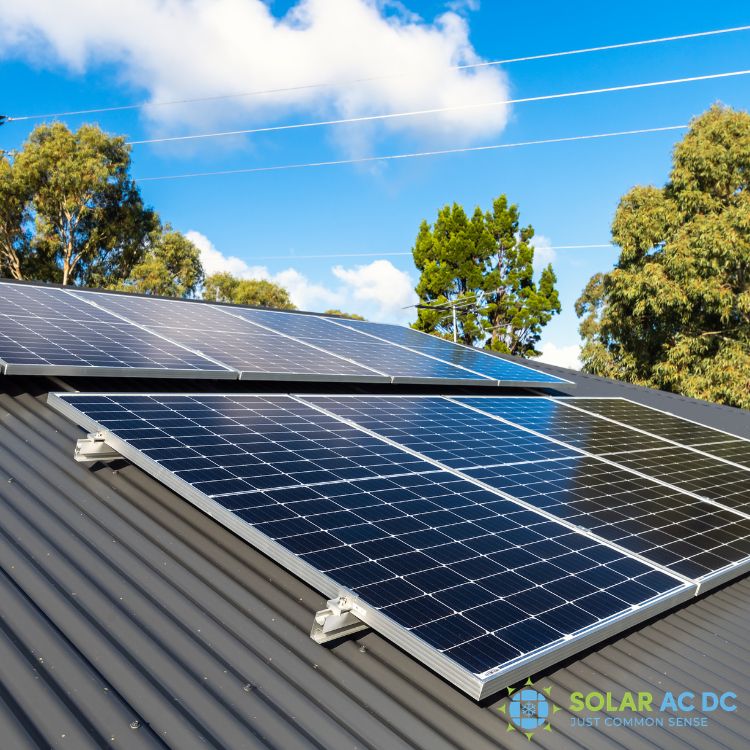
The air conditioner has a dedicated solar array sized specifically for the unit.
Those panels connect directly to the outdoor unit rather than feeding through the house solar inverter first.
That gives you a clearly defined solar source for the air conditioner and lets you see what the unit is doing through the WiFi app.
Running on solar through the day
Once there is enough available sunlight, the air conditioner can start automatically.
As solar production increases, more power is available to the unit.
This makes daytime cooling a natural fit.
The same hours that heat the roof, walls and windows are also the hours when the dedicated solar panels are producing power.
You can leave the system to operate through the day instead of waiting until the house has already become uncomfortable.
What happens at night
A hybrid Solar AC DC unit can use the property’s normal power supply when solar production falls away.
That lets the same unit continue cooling or heating after sunset.
If you only want solar operation, you can also choose to let the unit stop when there is no longer enough available solar.
Cloudy days and low light
Solar production changes with conditions.
When cloud cover reduces the output of the dedicated panels, the available solar contribution also falls. We recommend overloading the panels to ensure low light conditions still allow sufficient power.
Hybrid models can use the connected household supply when additional power is required. The grid power can be throttledd.
The WiFi app provides live visibility of solar and mains power use, so you can see where the unit’s power is coming from while it is running.
Why Solar Airconditioning vs Traditional Systems?
Both units cool a room. What separates them is how each one behaves when the power available to it is finite.

| Conventional split system | Solar AC DC | |
|---|---|---|
| Where the power comes from | Runs from the property’s existing AC supply, which usually means drawing from the battery bank, inverter or generator. | Runs directly from its own dedicated solar panels during daylight hours, separate from the house power system. |
| Effect on the battery bank | Air conditioning becomes another significant load that the battery bank needs to support whenever the unit is running. | During normal daytime solar operation, the air conditioner does not draw from the house battery bank. |
| Inverter requirements | The inverter needs enough capacity to operate the air conditioner alongside the other loads already running in the house. | The dedicated solar panels supply DC power directly to the air conditioner, so the house inverter does not need to carry the daytime cooling load. |
| Battery storage requirements | Longer air conditioner run times may require additional battery capacity, particularly if cooling continues into the evening. | No additional battery storage is required for the air conditioner to operate from its dedicated panels during the day. |
| How the solar power is used | Solar power is converted from DC to AC by the house inverter before it is available to the air conditioner. | DC power from the dedicated panels is supplied directly to the outdoor unit without first passing through a solar inverter. |
| During strong sunlight | The air conditioner continues drawing from the property’s AC system, with rooftop solar offsetting some or all of that demand depending on what the rest of the property is using. | The unit uses the power available from its dedicated solar array and can run independently of the house battery system during normal solar operation. |
| During passing cloud | The air conditioner continues demanding the power required to maintain output, with any solar shortfall coming from the battery bank, generator or other connected supply. | The unit responds to the solar power available. A hybrid system can use the connected supply when additional power is required. |
| At night | Continues operating from the property’s battery bank, generator or other AC supply. | A hybrid model can switch to the property’s existing power supply after solar production falls away, or the unit can be left to stop when solar is no longer available. |
| Generator use | On some off-grid properties, the generator is used to avoid placing the full air conditioning load on the batteries. | Daytime operation can come directly from the dedicated solar array, reducing the need to run the generator simply to power the air conditioner. |
| Visibility of power use | Power use is generally monitored through the property’s broader inverter, battery or energy monitoring system, if one is installed. | The WiFi app shows the air conditioner’s live solar and mains power draw, along with usage history and timers. |
| Impact on the existing off-grid system | Adding air conditioning can mean reassessing the inverter, battery storage, charging capacity and generator requirements of the property. | The dedicated daytime solar supply is separate from the existing house system, so the air conditioner can be added without resizing the house inverter or battery bank for daytime solar operation. |
| How it tends to be used | Owners may limit daytime use because they are conscious of the load being placed on the battery bank or generator. | The unit can be left to operate through the solar day, helping cool the building while dedicated solar power is available. |
How many panels a solar air conditioner needs
Most installations use four to eight dedicated panels.
The final number depends on:
- Air conditioner size
- Panel output
- Roof orientation
- Available installation space
- Property location
The dedicated array is designed around the air conditioner rather than added to the general household solar array.
Control over how your air conditioner uses power
For many homeowners, this is the biggest practical difference.
A normal split system gives you temperature control.
A solar air conditioner gives you more visibility over where its power is coming from as well.
Through the WiFi app you can access:
- Live solar draw
- Live mains draw
- Usage history
- Timers
- Operating controls
That makes it easier to understand how the unit is behaving throughout the day instead of treating air conditioning as an invisible load on the house.
Solar air conditioner specifications
| Specification | Detail |
|---|---|
| Available sizes | 3.5kW, 5.0kW, 7kw and 9.0kW |
| Operation | Reverse cycle |
| Daytime power | Direct DC solar |
| Typical panel array | 4 to 8 panels |
| Existing solar inverter | Separate |
| Existing solar array | Separate |
| Battery bank required | No |
| Charge controller required | No |
| Automatic solar start | Yes |
| Hybrid operation | Available |
| Monitoring | WiFi app |
| Battery-based model | 48V option available |
Solar air conditioning reviews from Australian homes
Use the full review rather than extracting a single sentence. His suburban 5kW hybrid installation is the closest match to the homeowner reading this page.
Solar air conditioning questions answered
Can I run my home air conditioner directly from solar panels?
A fully DC Solar AC DC unit can accept power directly from its own dedicated solar panels.
Those panels connect to the outdoor unit rather than feeding through a conventional solar inverter first.
Do I need batteries?
No battery bank is required for daytime operation from the dedicated solar panels.
If you want the unit to continue operating after solar production falls away, a hybrid model can use the normal household power supply.
Do I need to replace my existing rooftop solar?
No.
The air conditioner’s dedicated panels operate separately from the solar array already supplying your house.
Does it work at night?
A hybrid model can switch to your household power supply after available solar falls away.
Solar-only operation will stop when there is insufficient light.
What happens on cloudy days?
Available solar output falls with lower light levels.
The unit responds to the power available from its panels, while a hybrid model can use the connected household supply when required.
Can it heat the house as well?
Yes.
The available 3.5kW, 5.0kW, 7.0kW and 9.0kW models are reverse cycle systems providing heating and cooling.
How many solar panels do I need?
Most systems use between four and eight dedicated panels.
The final array is sized according to the unit, panel specification, roof orientation and location.
Can I see how much grid power it is using?
Yes.
The WiFi app provides live solar and mains power information along with usage history and timers.
Get a Quote for Solar Air Conditioning at Home
We will recommend a suitable unit and dedicated solar array for your home.