
OFF GRID Air ConditionERS
The solar panels wire straight into the air conditioner. No inverter, no battery bank, no charge controller.
Manufactured to Australian standards. Installed on off grid properties across WA, Queensland, the Northern Territory and regional NSW.
The battery bank problem with off grid air conditioning
Air conditioning can put a serious load on an off-grid power system.
A conventional split system needs AC power. If you run it from your battery bank, your inverter, batteries and charging system all need to be capable of carrying that additional load. If they are not, what started as an air conditioner quickly becomes an expensive power-system upgrade.
The alternative is often the generator, which means more fuel, more noise and more running hours.
Solar AC DC takes a different approach.
The air conditioner has its own dedicated solar panels, connected directly to the outdoor unit. During the day, it runs from those panels instead of putting another major load on your house batteries.
Your existing off-grid system stays exactly where it is, doing the job you originally built it to do.
No additional:
- Battery storage
- Solar inverter capacity
- Charge controller capacity
- Generator runtime during normal solar operation
You are not rebuilding the house power system around the air conditioner.
You are giving the air conditioner its own power source.
Built with DIY off-grid owners in mind
If you built or manage your own off-grid system, you probably do not need someone explaining solar panels to you.
You already understand where the sun falls on your property. You know where equipment can be mounted, what your existing system is doing and where another solar array makes sense.
That is where these systems are particularly practical.
You can plan where the indoor and outdoor units will go, choose the location of the dedicated solar array and work out its orientation before installation.
The quick-connect models also simplify the refrigeration side of the job.
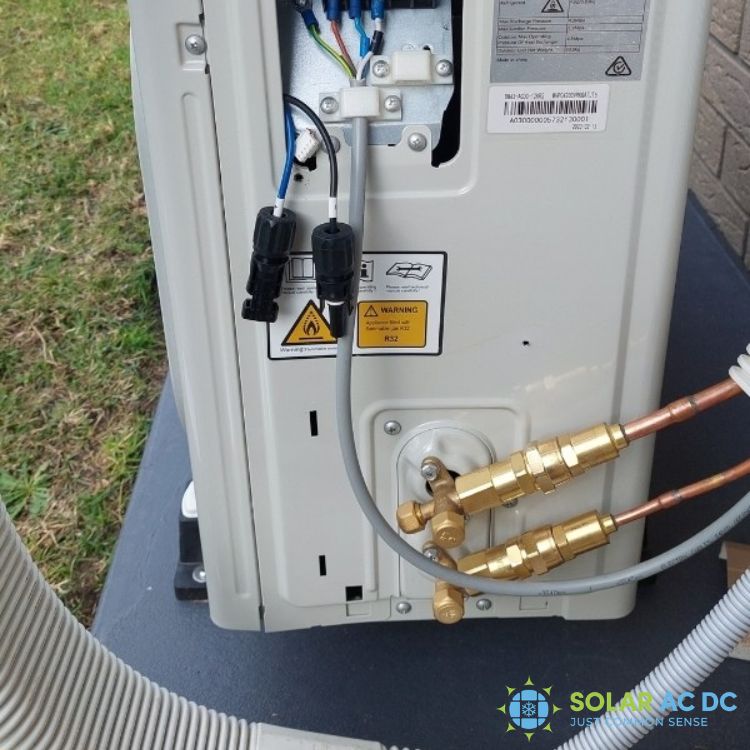
For pipe runs up to 5 metres, the refrigerant line set is supplied factory made, pre-charged and sealed. There is no on-site vacuuming, refrigerant charging or conventional line preparation required.
That means less specialised work needs to happen on the property and a simpler job for the installer, particularly when the property is hours from the nearest town.
What still requires a licensed installer?
There are parts of every split-system installation that remain licensed work.
The electrical connections and refrigerant connections must be completed by appropriately licensed trades.
The advantage here is not pretending those requirements disappear.
It is reducing how much work is left for them when they arrive.
You can do the thinking, positioning and planning beforehand. The licensed installer handles the connections that legally need to be handled by them.
How does solar airconditioning work?
New to solar airconditioning and curious as to how it works and whether it’s suitable for you? Watch the video below to hear from our very own Rob explain the key points about our solar aircon solutions.
During the day
Once there is enough available sunlight, the unit can start automatically and run from its dedicated panels.
As solar production changes throughout the day, the air conditioner adjusts with the available power.
Your house inverter and battery bank are left to run the rest of the property.
When the sun goes down
Most off-grid customers choose a hybrid model.
During daylight hours it can run from the dedicated solar array. After dark, it can switch across to the property’s existing power supply if you want the air conditioner to continue running.
If you would rather avoid any overnight draw, the unit can be operated on solar only and allowed to stop when there is no longer enough sunlight.
On cloudy days
Solar production naturally falls when cloud cover increases.
The air conditioner responds to the power available from the panels rather than blindly demanding the same amount of energy from your battery bank.
With a hybrid system, the existing power supply can supplement the solar input when required.
Why Solar Airconditioning vs Traditional Systems?
Both units cool a room. What separates them is how each one behaves when the power available to it is finite.

| Conventional split system | Solar AC DC | |
|---|---|---|
| Where the power comes from | Runs from the property’s existing AC supply, which usually means drawing from the battery bank, inverter or generator. | Runs directly from its own dedicated solar panels during daylight hours, separate from the house power system. |
| Effect on the battery bank | Air conditioning becomes another significant load that the battery bank needs to support whenever the unit is running. | During normal daytime solar operation, the air conditioner does not draw from the house battery bank. |
| Inverter requirements | The inverter needs enough capacity to operate the air conditioner alongside the other loads already running in the house. | The dedicated solar panels supply DC power directly to the air conditioner, so the house inverter does not need to carry the daytime cooling load. |
| Battery storage requirements | Longer air conditioner run times may require additional battery capacity, particularly if cooling continues into the evening. | No additional battery storage is required for the air conditioner to operate from its dedicated panels during the day. |
| How the solar power is used | Solar power is converted from DC to AC by the house inverter before it is available to the air conditioner. | DC power from the dedicated panels is supplied directly to the outdoor unit without first passing through a solar inverter. |
| During strong sunlight | The air conditioner continues drawing from the property’s AC system, with rooftop solar offsetting some or all of that demand depending on what the rest of the property is using. | The unit uses the power available from its dedicated solar array and can run independently of the house battery system during normal solar operation. |
| During passing cloud | The air conditioner continues demanding the power required to maintain output, with any solar shortfall coming from the battery bank, generator or other connected supply. | The unit responds to the solar power available. A hybrid system can use the connected supply when additional power is required. |
| At night | Continues operating from the property’s battery bank, generator or other AC supply. | A hybrid model can switch to the property’s existing power supply after solar production falls away, or the unit can be left to stop when solar is no longer available. |
| Generator use | On some off-grid properties, the generator is used to avoid placing the full air conditioning load on the batteries. | Daytime operation can come directly from the dedicated solar array, reducing the need to run the generator simply to power the air conditioner. |
| Visibility of power use | Power use is generally monitored through the property’s broader inverter, battery or energy monitoring system, if one is installed. | The WiFi app shows the air conditioner’s live solar and mains power draw, along with usage history and timers. |
| Impact on the existing off-grid system | Adding air conditioning can mean reassessing the inverter, battery storage, charging capacity and generator requirements of the property. | The dedicated daytime solar supply is separate from the existing house system, so the air conditioner can be added without resizing the house inverter or battery bank for daytime solar operation. |
| How it tends to be used | Owners may limit daytime use because they are conscious of the load being placed on the battery bank or generator. | The unit can be left to operate through the solar day, helping cool the building while dedicated solar power is available. |
How many solar panels do you need?
Most installations use approximately four to eight dedicated solar panels, depending on:
- Air conditioner size
- Panel output
- Roof or array orientation
- Property location
- Available sunlight
- The area being cooled
The panels belong to the air conditioner rather than your house solar system.
That separation is important.
Adding air conditioning does not mean resizing the solar array, inverter and batteries that already run your home.
Tell us your postcode, the size of the area you want to cool and what your current power setup looks like, and we can recommend an appropriate system and array.
How our off grid air conditioning runs without batteries or an inverter
These units are fully DC. They accept raw, variable DC power directly from a dedicated set of solar panels, so the power does not need to be conditioned, stored or converted before the unit can do anything with it. The panels wire straight into the outdoor unit and the air conditioning installer does that work at the same time as the install. There is more detail on the input the units will accept in the technical information on the DC air conditioning system.

Split

Ducted

Cassette

Multihead

Window
DIY Solar Air Conditioning
For those interested in a do-it-yourself solution, Solar ACDC offers a range of easy-to-install DIY solar air conditioning systems.
3.5 KW DIY Solar Air Conditioning System
This unit is designed for simple installation, requiring minimal tools and technical knowledge. With quick-connect MC4 terminals and a plug-and-play setup, you can have your 3.5 KW unit up and running in no time, enjoying solar-powered cooling almost immediately.
7 KW DIY Solar Air Conditioning System
The 7 KW DIY option offers powerful cooling for larger spaces, with the same user-friendly installation process. This unit can be easily connected to existing solar panel setups, giving you the flexibility of solar-powered air conditioning without the need for complicated electrical work.


Split Hybrid Solar Air Conditioners
Our Hybrid Solar Air Conditioners are adaptable to both off-grid and on-grid scenarios. In off-grid mode, the system runs directly on solar power, turning on automatically when there’s enough sunlight.
At night or during low solar production, it can mix in battery or grid power, ensuring uninterrupted cooling. The AC limiter ensures minimal power consumption, using as little as 300W when necessary.

Ducted Air Conditioning
Solar ACDC’s ducted solar air conditioning systems are designed to provide energy-efficient and eco-friendly cooling solutions for homes and commercial spaces.
Utilizing solar power during the day, these systems help reduce electricity bills while delivering powerful performance. Whether you’re seeking to enhance your comfort or reduce your environmental footprint, our ducted air conditioners are the ideal solution.

Cassette Solar Air Conditioning
Solar ACDC’s cassette solar air conditioning units are the perfect solution for those seeking an efficient, unobtrusive cooling option for commercial or residential spaces.
Designed to operate primarily on solar power, these units are highly effective during the day when cooling demand is highest. This setup not only reduces electricity bills but also offers a more eco-friendly alternative to traditional air conditioning systems.

Multihead Hybrid Solar Air Conditioners
Solar ACDC’s Multihead Hybrid Solar Air Conditioning systems are ideal for homes or small commercial setups that need flexible room-by-room climate control without sacrificing energy efficiency. These systems allow one outdoor unit to connect to multiple indoor heads, giving you zoned comfort with minimal roof or wall clutter.
Powered directly by solar energy during daylight hours, each indoor head operates with whisper-quiet brushless DC motors and features smart load control to reduce reliance on grid or battery power after sunset. The system can function entirely off-grid or switch between solar and AC power as required. It’s a smart option for making the most of your solar investment across several rooms without overloading your system.

Window Hybrid Solar Air Conditioners
Solar ACDC’s Window Hybrid Solar Air Conditioner offers a straightforward, all-in-one solution for solar-powered cooling. Purpose-built for off-grid or hybrid operation, it’s an ideal choice for single rooms, site offices, cabins, or portable buildings where traditional split or ducted systems might not suit.
Running directly from solar power during the day with no inverter required, the unit automatically balances between solar, grid, or battery sources to maintain performance as conditions shift. Can be operated solely from solar panels with the unit autostarting when the sun is up, perfect for no power locations. With plug-and-play setup and no external piping, it’s quick to install and even easier to operate.
DIY Solar Air Conditioning
For those interested in a do-it-yourself solution, Solar ACDC offers a range of easy-to-install DIY solar air conditioning systems.
3.5 KW DIY Solar Air Conditioning System
This unit is designed for simple installation, requiring minimal tools and technical knowledge. With quick-connect MC4 terminals and a plug-and-play setup, you can have your 3.5 KW unit up and running in no time, enjoying solar-powered cooling almost immediately.
7 KW DIY Solar Air Conditioning System
The 7 KW DIY option offers powerful cooling for larger spaces, with the same user-friendly installation process. This unit can be easily connected to existing solar panel setups, giving you the flexibility of solar-powered air conditioning without the need for complicated electrical work.
Running the air conditioner off grid during the day
Once there is enough light in the morning, the auto start function brings the unit on. From that point it runs on its own panels and takes nothing from the house system, then shuts itself down in the afternoon when the light drops away. Your inverter and your battery bank sit out the entire cycle. The WiFi app shows live solar draw alongside mains draw, so you can watch what it is actually doing rather than take our word for it.
Running the air conditioner off grid at night
Most off grid customers go with a hybrid unit for this reason. A power switch can move it across to the existing power supply after dark, so it keeps running on the same system that runs the rest of the house. It can also be left on solar only, in which case it simply stops when the light goes rather than drawing power from anywhere else. The AC power limiter caps what the unit can take from the connected supply anywhere from 0 to 300W, 400W or 600W so you set the ceiling yourself. The hybrid solar air conditioner range covers how that limit works across all three sizes.
Off grid air conditioning on overcast days
Output follows the light, so heavy cloud means less cooling. On a hybrid unit the connected supply picks up the shortfall within whatever limit you have set, and the unit keeps running. On a solar only setup, the unit runs at reduced capacity while there is light to work with and stops when there is not. For properties running fully off grid with storage already in place, there is also a separate 48 volt off grid air conditioner built for battery based systems, however we generally recommend the Hybrid due to the off grid features we have built into it. But yes we have both options.
How many solar panels an off grid air conditioner needs
Three or four is the floor. A 3.5kW unit on a well oriented roof can run on as few as three 475W panels, and most installations land somewhere between four and eight depending on unit size, roof aspect and how far south the property sits. Put the area you want cooled and your postcode on the form below and we will size the array for your property. If you have your own panels please let us know what you have and we can confirm the best fitment.
Off grid air conditioner specifications
| Specification | Detail |
|---|---|
| Sizes | 3.5kW, 5.0kW, 7.0kW and 9.0kW |
| Type | Reverse cycle, heating and cooling |
| Power input | Direct DC from dedicated panels |
| Panels required | 4 to 8, maximum 10 |
| Inverter | Not required |
| Battery bank | Not required |
| Charge controller | Not required |
| Cooling range | 0°C to 55°C |
| Heating range | -5°C to 20°C |
| Grid AC power limiter | 0 to 300W, adjustable |
| Auto start | Yes, on available light |
| Night operation | Switches to existing supply |
| Control | WiFi app |
| Fully off grid option | 48 volt DC unit |
| Standards | Built to Australian standards |
Off grid air conditioning reviews from Australian properties
Check out some of our solar AC reviews. If you want to keep reading, we have also been featured on Channel 7 News, and there are more customer reviews from installations around Australia.
Frequently Asked Questions
48v vs Hybdrid
We are often contacted and asked for 48v air condiitoners for an off grid location. We don’t always recommend the 48v units for this purpose. Actually, we have specifically designed the hybrid for off grid application.
A 48v air conditioner has one main benefit, it avoids an inverter and operates at 48v, they can operate directly from a 48v battery. They can be quite efficient but don’t have many controls to reduce consumption.
Our Hybrid air conditioners have many advantages for off grid. Firstly they use a dedicated set of panels therefore do not need to draw anything from an existing battery system during daylight hours. This is particularly beneficial when there are low light senarios: cloudy but humid, sunny with some cloud, shade from trees etc… These situations can be tricky for a battery system operating a normal air conditioner as the air conditioner will draw from the charge controller and the charge controller will always supply the load first. The traditional air conditioner or 48v air conditioner does not change its performance as it is unaware of the power production and simply draws what it wants which means often all the power from the panels and possibly also from the battery. Runing the risk that the battery is only partially charged or even completely flat at the end of daylight hours.
Our hybrid will ramp the compressor up and down with the available power and if disconnected from the batteries it will simply turn itself off at the end of the sunlight hours allowing for the batteries to have charged as much as possible during the day. Secondly if the air conditioner is connected to the batteries, the purpose built AC limiter will only draw a nominal amount if required eg. 300 watts to maintain operation.
At night time our Hyubrid will keep operatingat a minimal power load 30w, 400w or 600w depending on the size of the air conditioner. 48v or normal air conditioners will simply operate at whatever power draw they want which is normally 3-4 times higher than our systems.
Why should I choose solar aircon
The hybrid unit switches across to your existing power supply after dark using a switch on the unit. The grid AC power limiter caps what it can draw from that supply, adjustable from 0 to 300W. If the unit is set to solar only, it stops when the light goes rather than pulling power from your system.
What happens at night with an off grid air conditioner?
The hybrid unit switches across to your existing power supply after dark using a switch on the unit. The grid AC power limiter caps what it can draw from that supply, adjustable from 0 to 300W. If the unit is set to solar only, it stops when the light goes rather than pulling power from your system.
Does it still work on a cloudy day?
Yes, at reduced output. The unit takes whatever the dedicated panels are producing, so heavy cloud means less cooling capacity. On a hybrid unit the connected supply covers the shortfall up to the limit you have set. On a solar only setup, the unit will stop if the light drops below what it needs to run.
How many solar panels does an off grid air conditioner need?
A 3.5kW unit can run on as few as four 300W panels. Most installations sit between four and eight panels, with the final number depending on unit size, roof orientation and the location of the property. Send through the area you want cooled and your postcode and Solar AC DC will size the array for your property.
Will it drain my battery bank?
Not during the day. The unit runs on its own dedicated solar panels and takes nothing from the house system while there is sufficient light. At night, a hybrid unit draws from your existing supply, and the power limiter lets you cap that draw anywhere from 0 to 300W, including setting it so the unit takes nothing at all.
Do I need an electrician to install it?
The unit is installed by an air conditioning installer, who also wires the dedicated panels directly into the outdoor unit. There is no inverter, battery bank or charge controller to install alongside it, so there is less equipment on site than a conventional off grid air conditioning setup requires. Contact Solar AC DC before booking the install and the requirements for your property will be confirmed first.
What happens if it breaks down and I am hours from town?
Support comes direct from Solar AC DC, so there is no distributor or call centre sitting between you and an answer. The person who picks up the phone knows the unit. The review from Steven Zacharias on this page describes a fan motor fault on a remote property being diagnosed and dealt with directly, including a second issue sorted the same night by text.
How much does an off grid air conditioner cost?
It depends on the size of the unit, the number of solar panels required and what the installation involves at the property. A shed and a four bedroom homestead are two different jobs. Complete the quote form with your postcode and the approximate area you want cooled and Solar AC DC will come back with a figure for your situation.
Can it be used for heating as well as cooling?
Yes. All three sizes are reverse cycle, so the same unit handles heating and cooling. The operating range runs from -10°C to +58°C, which covers cold inland mornings as well as summer in the north.
Get a quote for off grid air conditioning
The more you can tell us about the property and how it is powered, the closer the first number will be. Postcode, the area you want cooled and your current setup are the three that make the most difference.