
Commercial Solar Air Conditioning
Put dedicated solar generation directly behind the cooling load that operates through your working day.
Solar AC DC systems are suited to offices, schools and commercial spaces where air conditioning demand is concentrated during daylight hours.
Why daytime cooling demand suits commercial solar air conditioning
Air conditioning in a school, office or commercial building often follows a predictable pattern.
People arrive in the morning.
Cooling demand increases as the building heats up.
The system works through the middle of the day.
Demand then falls as the site empties in the afternoon or evening.
Those operating hours line up closely with the hours a solar array is producing power.
Solar AC DC systems use that overlap directly.
Each air conditioner can accept DC power from dedicated solar panels, allowing solar generation to supply the unit without first passing through a conventional solar inverter.
For sites with a strong daytime cooling requirement, that gives facilities managers a straightforward question to assess:
How much of the cooling requirement can be placed directly behind dedicated solar generation during operating hours?
That is the starting point for the site assessment.
How commercial solar air conditioning works without an inverter
The solar panels allocated to the air conditioner connect directly to the outdoor unit.
The unit accepts variable DC power and adjusts to available solar input.
A battery bank and charge controller are not required for daytime solar operation.
Where operation is also required outside available solar hours, hybrid models can use the site’s existing electrical supply.
This gives commercial sites flexibility around when dedicated solar is available while retaining normal operation when required.
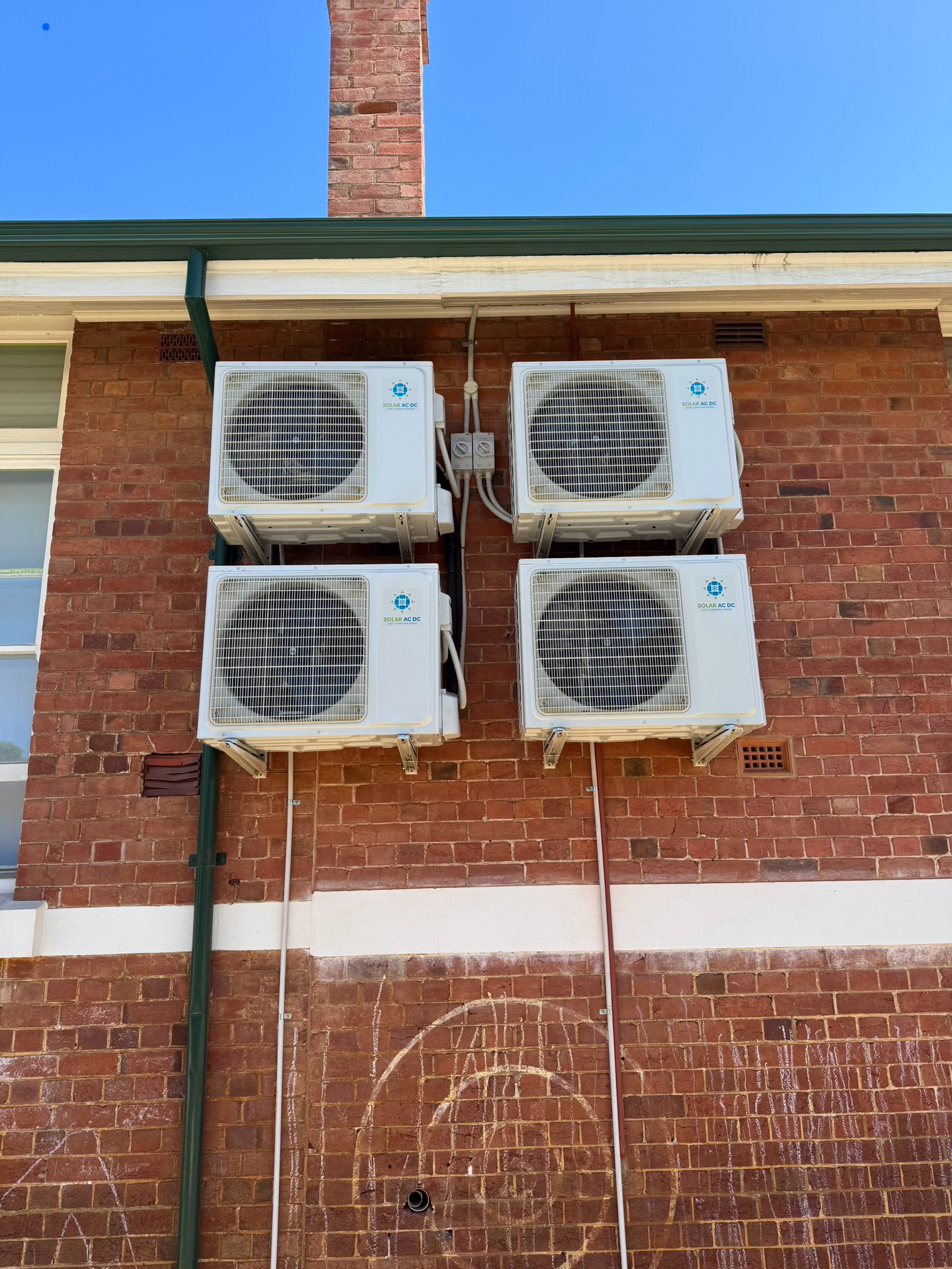
Multiple units across a site
A single classroom and a multi-building school are different design jobs.
The same applies to an office with one open-plan area compared with a site containing meeting rooms, reception areas, workshops and separate tenancies.
Multi-unit installations need to be assessed around:
- Number of areas requiring cooling
- Size and use of each space
- Available locations for dedicated solar arrays
- Existing electrical infrastructure
- Hours of occupancy
- Daytime and after-hours requirements
Solar AC DC will assess the site rather than assuming that a single-unit residential layout can simply be repeated across a larger property.
Demand response and DRED compliance
An optional DRED module is available for applications requiring demand response capability.
The module supports DRM1, DRM2 and DRM3 and is compliant with AS/NZS 4777.2.
If demand response requirements apply to your site, include that information in the enquiry so the appropriate system configuration can be assessed.
Metering, monitoring and reporting
Commercial buyers need to understand what equipment is doing after it has been installed.
The WiFi app provides access to:
- Live solar draw
- Live mains draw
- Usage history
- Timers
- Unit controls
That provides facilities teams with visibility into the relationship between dedicated solar generation and the air conditioner’s use of the connected supply.
For a site assessment, we can also discuss how units would be grouped and monitored across the property.
Why Solar Airconditioning vs Traditional Systems?
Both units cool a room. What separates them is how each one behaves when the power available to it is finite.

Power visibility ConventionalUses power you cannot see, and as much as it likes Solar AC DCAll consumption visible live, from the panels and from the battery supply
A conventional unit gives you no feedback at all. It draws what it draws, and usually a lot, and the first you know about it is what the bank looks like that evening. Every watt the Solar AC DC unit uses is visible live in the app, both the solar side and the draw from the battery supply, with usage history behind it.
Power path ConventionalDC converted to AC, then back to DC for the compressor Solar AC DCRaw DC straight from the panels
A conventional unit runs on converted power. DC from the panels is inverted to AC, then the unit rectifies it straight back to DC for the compressor. There are losses at each conversion, which makes an already heavy load less efficient again. A fully DC unit takes raw DC power directly from its own panels and skips both conversions.
Low light and passing cloud ConventionalTakes what it needs without ramping down, from panels or batteries or both Solar AC DCRamps up and down with available power, limiter caps any top up
This is where it matters most. When a cloud passes or the day is overcast, a conventional unit simply takes what it needs. It does not ramp down and it does not account for what it is costing. That power comes from the panels that should be charging the battery, because the charge controller supplies the load before it charges. If there is no panel power, it takes battery power, and it will take both at once, drawing the balance from the batteries if solar is insufficient. You can end up with a bank that never charged, or one depleted far enough that there is little or nothing left for the house that night.
A Solar AC DC unit uses only the power from its own panels, ramping up and down as that power varies. If the connection to the batteries is left on, locking in the AC limiter means it will only draw from them when solar drops below the set limit. On a 7kW unit with AC limiting locked in, the panels supply up to 2,500W. As the unit ramps down it draws from the batteries only once solar falls below 600W. With 400W available from the panels it adds 200W from the batteries, rather than the 2,100W a conventional unit would take.
Night and 24 hour consumption ConventionalDraws what it wants, when it wants Solar AC DCOwn panels by day, AC limited power at night
Night time and full 24 hour running is where a conventional unit becomes very difficult off grid, because it draws what it wants when it wants it. A 7kW unit draws between 1,500W and 2,500W. At a conservative average of 1,800W that is 43.2kWh over 24 hours. A 3.5kW unit draws between 500W and 1,200W, so conservatively 700W, or 16.8kWh. On a sunny day the array can cover some of that, but from 6pm to 10am it still works out at 28.8kWh for the 7kW and 11.2kWh for the 3.5kW. On a cloudy day consumption is full.
Running on independent panels means the unit uses its own panel power through daylight hours and AC limited power at night. A 7kW unit at 600W for 14 hours is 8.4kWh, and a 3.5kW unit 4.2kWh. The practical effect is that the unit can be left on through the evening without a meaningful draw on the batteries.
Effect on battery life ConventionalConstant high draw and deep depletion shortens bank life Solar AC DCMinimal depletion, batteries replaced less often
Constant high power usage and repeated deep depletion reduces the working life of a battery bank. It is a cost that does not appear on any quote and does not show up until the bank needs replacing earlier than it should have. Keeping depletion minimal extends the interval between replacements.
How it ends up being used ConventionalLeft off through the day, then run hard at night Solar AC DCLeft on to auto start, run all day, stop at dusk
Off grid, people usually switch a conventional air conditioner off during the day because they are not sure what it is drawing. Then it runs at full power through the evening, depleting the bank fast at exactly the wrong time, and coming home to a hot house in summer is nobody's idea of a good afternoon.
A unit that can be disconnected from the batteries entirely is worth leaving on. It auto starts in the morning, runs through the day and stops itself at night. That changes the thermal load of the building, so the unit has far less work to do after dark. The house is comfortable to come back to, there is less heat damage to food, vinyl seats, artwork and anything else that suffers in a hot room, and the pets have a better day of it too.
Commercial applications
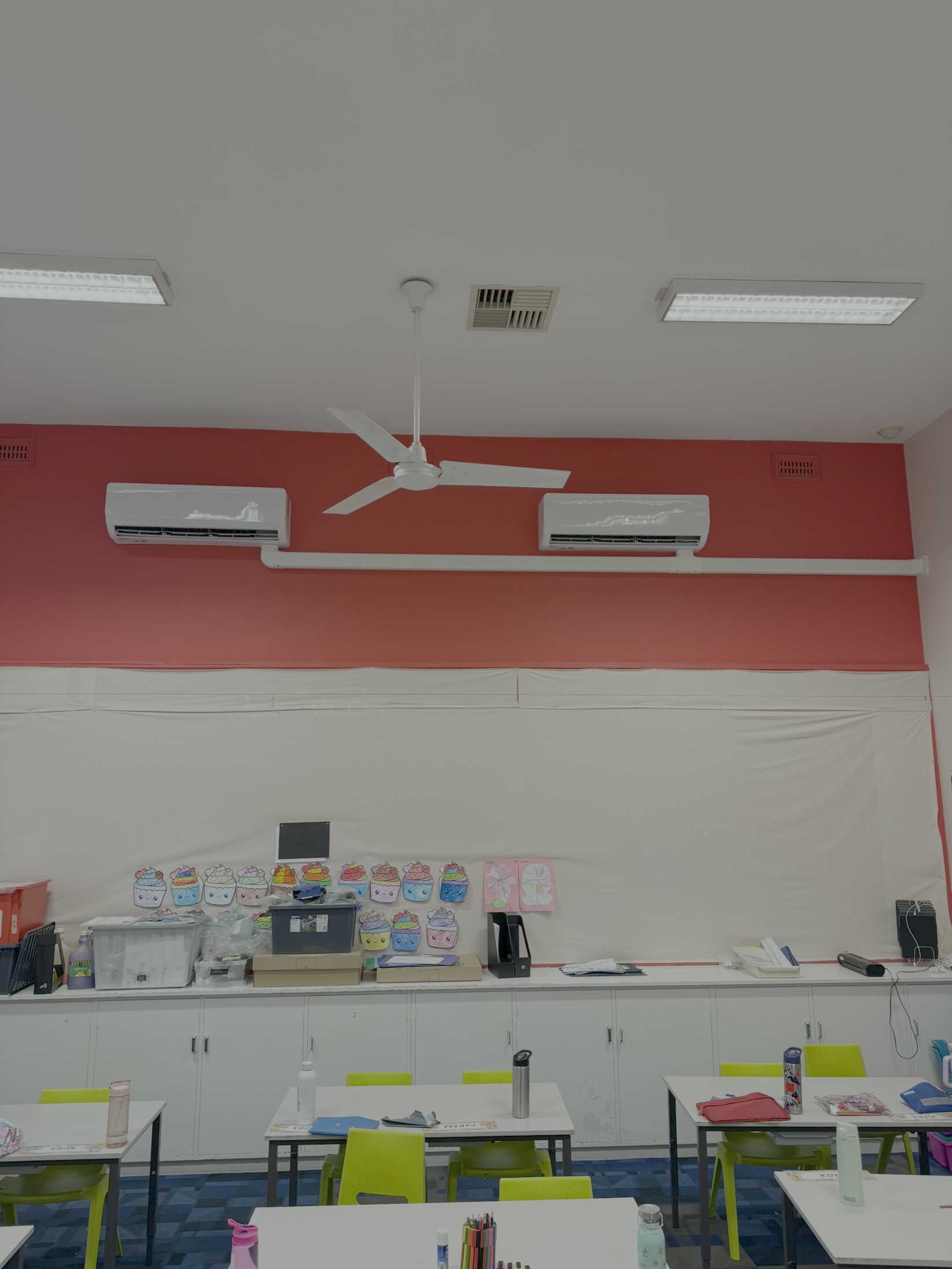
Schools
Classrooms are heavily occupied during daylight hours, which closely matches solar availability.
Systems can be assessed classroom by classroom or across larger teaching blocks depending on the site.
Offices
Office cooling demand is generally concentrated through the working day.
Dedicated solar air conditioning can be considered for open-plan work areas, meeting rooms, reception areas and other regularly occupied spaces.
Workshops and commercial facilities
Workshops, depots and other daytime facilities can also suit the same operating pattern.
Building construction, door openings, machinery and internal heat loads need to be considered during sizing.
Retail and customer-facing spaces
Where trading hours extend into the evening, a hybrid system can use dedicated solar during the day and the site’s existing supply when solar production falls away.
Commercial solar air conditioner specifications
| Specification | Detail |
|---|---|
| Available sizes | 3.5kW, 5.0kW and 7.0kW |
| Operation | Reverse cycle |
| Daytime power | Direct DC solar |
| Typical panel array | 4 to 8 panels |
| Existing solar inverter | Separate |
| Existing solar array | Separate |
| Battery bank required | No |
| Charge controller required | No |
| Automatic solar start | Yes |
| Hybrid operation | Available |
| Monitoring | WiFi app |
| Battery-based model | Available sizes 3.5kW, 5.0kW and 7.0kW Operation Reverse cycle Daytime input Direct DC solar Typical panels 4 to 8 Battery bank required No Charge controller required No Automatic solar start Yes Hybrid operation Available Monitoring WiFi app Suitable spaces Sheds and workshops |
Commercial solar air conditioning questions answered
Is solar air conditioning suitable for schools?
Schools are a strong operational fit because classroom cooling demand is concentrated during daylight hours.
The final design depends on classroom size, number of rooms, available panel locations and the electrical infrastructure at the school.
Can solar air conditioning be used in an office?
Yes.
Dedicated solar air conditioning can be assessed for individual offices, open-plan areas, meeting rooms and larger commercial spaces.
Can several units be installed across one site?
Yes, although a multi-unit commercial site should be assessed as a complete project.
The number of systems, dedicated arrays, unit locations and electrical requirements need to be planned around the property.
Does each air conditioner need its own solar panels?
The system design uses dedicated solar input to the air conditioning equipment.
The final array layout across a commercial site should be determined during the site assessment.
What happens outside daylight hours?
Hybrid models can use the existing electrical supply when solar power is unavailable or insufficient.
Do the systems require batteries?
No battery bank is required for normal daytime operation from the dedicated solar panels.
What monitoring is available?
The WiFi app provides live solar and mains draw, usage history, timers and operating controls.
Is demand response available?
An optional DRED module supports DRM1, DRM2 and DRM3 and is compliant with AS/NZS 4777.2.
Include any demand response requirements when requesting a site assessment.
Can you provide projected savings or payback?
Any meaningful projection needs to be based on the actual property, operating hours and energy use.
Solar AC DC does not use generic percentage savings or payback claims as a substitute for assessing the site.
Where energy performance needs to form part of a business case, discuss the available data requirements during the assessment.
Enquire About a Commercial Site Assessment
We can then determine whether Solar AC DC is a suitable fit and what information is required for the next stage.